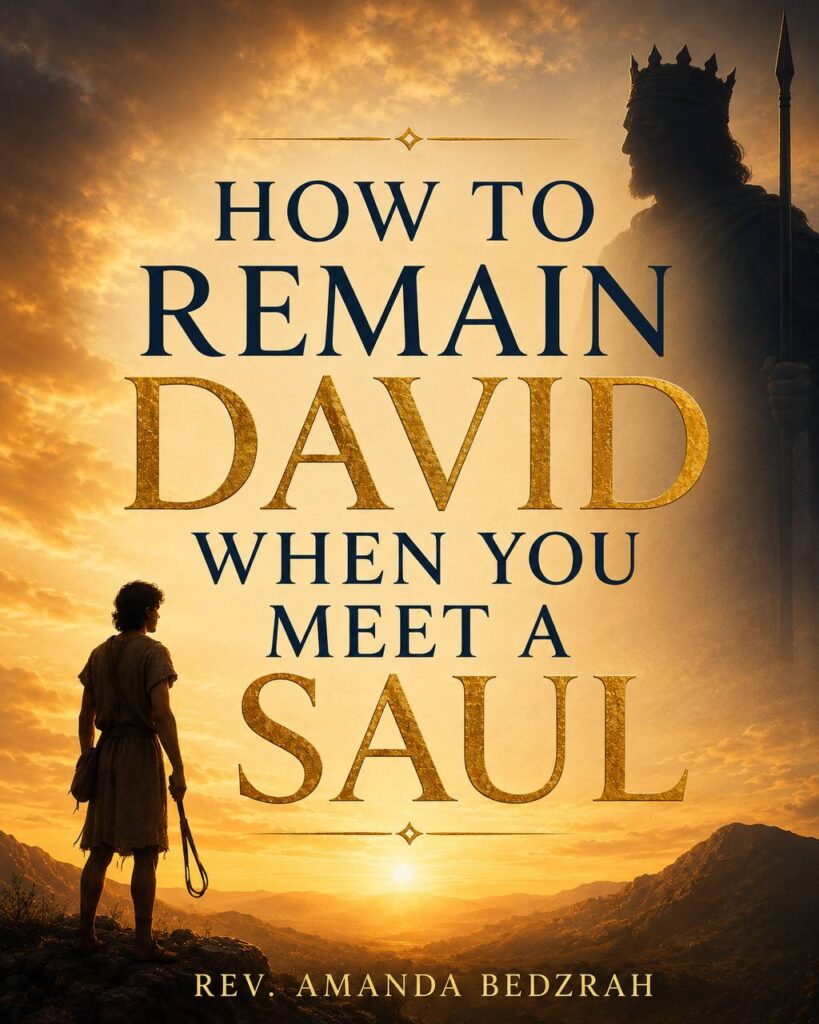

How to Remain David When You Meet a Saul
As I’ve been reading through 1 Samuel, I have found myself fascinated by the relationship between Saul and David.
The truth is, most of us will encounter a Saul at some point in our lives.
What makes the story so painful is that Saul was not always David’s enemy. David served Saul faithfully. He fought his battles, played music to soothe him when he was troubled, honoured him as king and remained loyal to him. If anyone should have wanted David around, it was Saul.
Yet somewhere along the journey, something changed.
The women began to sing, “Saul has slain his thousands, and David his ten thousands” (1 Samuel 18:7). Suddenly, Saul started looking at David differently. The same David he once trusted became a threat. The same David he once promoted became someone he wanted removed.
As I read this story, I am struck by how familiar it feels.
Many of us have experienced relationships that changed for reasons we could not understand. People who once encouraged us suddenly became distant. People who once opened doors began quietly closing them. People who once celebrated us became uncomfortable when others started celebrating us too.
The Bible tells us what was happening beneath the surface: “Saul was afraid of David because the Lord was with David” (1 Samuel 18:12).
That verse explains so much.
Saul’s problem was not really David. Saul was afraid of what he could see God doing in David’s life. He could see God’s favour. He could see God’s presence. He could see God’s hand upon him. Instead of celebrating it, he felt threatened by it.
Fear turned into jealousy, jealousy turned into manipulation and manipulation turned into hostility. Saul had one goal in mind: to stop David becoming who God had called him to be.
Saul made promises he did not keep. He gave with one hand and took with the other. He sent David into dangerous situations hoping he would not return. He watched him constantly. He looked for opportunities to bring him down. What started as insecurity eventually consumed him.
As I read this story, I am reminded that sometimes people’s behaviour has very little to do with you and a lot to do with what is happening inside them. Their fear, insecurity, pride or trauma can cause them to react to God’s blessing on your life in ways that make little sense. And as painful as that realisation is, it is also strangely freeing, because it means you are not responsible for fixing what was broken long before you arrived.
The temptation when dealing with a Saul is to become consumed by Saul. Why are they behaving like this? What have I done wrong? How do I defend myself? How do I expose them? How do I get even?
Yet the real lesson in this story is not Saul’s behaviour. It is David’s response.
David was not naive. When Saul threw spears, David moved. When Saul became dangerous, David acted. When his life was at risk, David fled. He exercised wisdom and took practical steps to protect himself. What David refused to do was become Saul.
He refused to allow Saul’s jealousy to make him jealous. He refused to allow Saul’s bitterness to make him bitter. He refused to allow Saul’s hatred to change his character. Even when opportunities for revenge presented themselves, David refused to take them. And I think we need to pause there for a moment, because that is not a small thing. Holding your integrity together while someone is actively working to pull you down, staying kind when you have every reason not to, choosing not to retaliate when you could, that takes a kind of grace that does not come naturally. It has to be chosen, sometimes daily, sometimes in the same hour.
David understood something many of us are still learning. If God has made a promise, you do not have to destroy a Saul to fulfil it. Your kingship is not dependent on dethroning anyone else. Your elevation is not dependent on someone else’s downfall.
One of my favourite moments comes in 1 Samuel 24. David has every opportunity to take matters into his own hands. Instead, he leaves his case with God and says: “May the LORD be our judge and decide between us. May he consider my cause and uphold it; may he vindicate me by delivering me from your hand” (1 Samuel 24:15).
David did not deny the injustice or minimise the pain. He did not pretend Saul’s behaviour was acceptable. He simply refused to take God’s place as judge.
Perhaps that is the lesson for all of us.
You cannot stop every Saul from being a Saul. You cannot heal their insecurity and you cannot force them to celebrate what God is doing in your life. But you can remain David.
Walk in wisdom. Protect your heart. Leave room for God to work. Refuse to allow another person’s behaviour to change who God has called you to be.
And when the temptation comes to fight your own battle, remember David’s words:
“May the LORD be our judge and decide between us.”
Sometimes the greatest act of faith is trusting God enough to handle what only He can. I have had to learn that in my own life, and I suspect many of you are learning it too. The cave is not the end of the story. The waiting is not the end of the story. God was writing something in David that the throne alone could never have produced, and He is doing the same in you.
With love,
Rev. Amanda Bedzrah