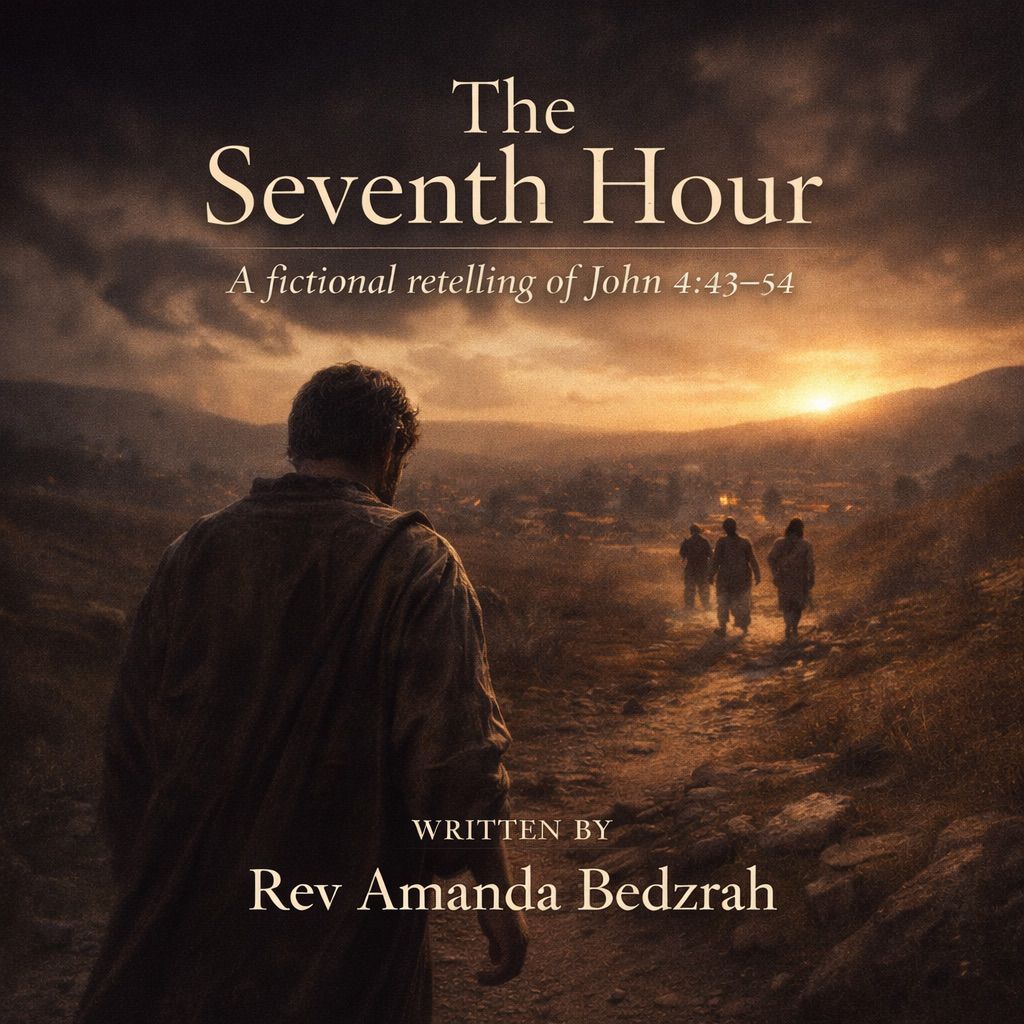

The Seventh Hour
A fictional retelling of John 4:43–54
Written by Rev Amanda Bedzrah
By the third night, the house in Capernaum had grown quiet in the way houses do when hope begins to fade. The courtyard fountain had been stilled. Servants walked quietly, closing the doors carefully so hinges would not creak. The smell of crushed herbs lingered in the air, sharp and medicinal, failing to disguise the heavier scent of sickness.
Elizabeth had not left her son’s side. She sat on the woven mat with Elior’s head resting against her lap, counting each breath as though it were a fragile possession that might disappear if not guarded. His skin burned against her palms. When she dipped the cloth in cool water and pressed it to his forehead, steam seemed almost to rise from him.
He had stopped speaking that morning. That frightened her more than the fever. His father, Chuza stood in the doorway, watching them.
In the courts of Herod Antipas, his name carried influence. He advised, negotiated, and resolved matters that affected entire districts. When he entered chambers, men straightened. When he issued instruction, it was obeyed. Yet, in his own house, before the mat where his son lay, his authority had dissolved into helplessness.
The physician had already spoken the night before, his words were devastating. “Master,” he had said quietly, “I fear we are near the end.”
At first, Elizabeth didn’t weep. She had simply leaned over her son and whispered into his hair, her lips moving without sound. Only when the room emptied did her shoulders begin to tremble. Silence and tears collided in an unusual way.
“Do something,” she whispered to her husband without looking up when he returned. But Chuza had done everything he knew and still the fever clung. A servant entered the room without invitation and bowed low slightly trembling.
“Master,” he stuttered “… the teacher from Nazareth has returned to Cana.”
Chuza’s eyes lifted. The wedding in Cana had been spoken of across Galilee, where water miraculously turned to wine. He heard the story from this same servant, who had heard it from his sister who was at the wedding, she claimed to have filled two pots herself. Still, Chuza had dismissed the story. Galilee loved tales and exaggeration. But what if? He pondered. Hope unwanted is useless but when hope is needed even a glimmer becomes a lifeline.
Cana was nearly a day’s journey. Chuza, holding on to that glimmer was willing to take the risk.
Elizabeth’s voice sharpened with fear. “You cannot leave. What if he dies while you are gone?”
Her words pierced deeper than accusation. If he stayed and Elior died, he would watch it happen.
If he left and Elior died, he would not be there at his son’s last breath. He knelt beside his son, lowering himself without regard for dignity. He pressed his forehead against Elior’s burning hand.
“I will return,” he whispered.
He did not know whether that promise was faith or desperation, or reckless hope based on a tale. What he couldn’t do was watch his son die, knowing there was a man in Cana who could save him. Elizabeth caught his arm as he rose.
“If he asks for you…” Her voice broke.
Chuza closed his eyes briefly. “If there is even a breath of hope on that road, I must take it.”
She released him, even with uncertainty, because love sometimes forces surrender.
The road to Cana stripped him of reason. It was not a story he could tell to his peers lest they call him mad. Dust clung to his garments and filled his sandals. He walked alone, quickly with urgency in his stride though pride travelled beside him causing inner turmoil.
His shoulder lifted slightly as pride crawled through his veins. He was a royal official. He did not kneel before wandering teachers. He did not beg in crowded marketplaces. He was accustomed to being honoured and respected. What would it mean to his reputation to humble himself publicly? What if this teacher refused to see him or help him? His thoughts gave the distance company and soon he was in Cana.
By the time he arrived, Jesus was surrounded by Galileans who welcomed Him warmly. Those who had seen signs in Jerusalem leaned forward with expectation. Word had travelled far and wide.
Chuza did not stand at the edge. He pressed forward through the crowd, his rank forgotten as he fought his way right before Jesus. Soon, he stood before him, staring at the teacher, suddenly all his rehearsed words were gone.
“Sir,” he said, the title catching in his throat, “my son, he is sick. Please come with me and heal him.” Moisture gathered around his eyes without invitation. A mixture of fear and shame rushed through him but it was swiftly silenced by hope. The plea carried no authority, just desperation.
Jesus paused, shook His head, lifted his eyes to the crowd, then settled his gaze on Chuza.
“Unless you people see signs and wonders, you will not believe.”
The words, spoken loudly, landed with force.
You people!
Chuza felt heat rise in his chest. He had travelled miles. He had left a dying child. He had bent pride into humility and now he was grouped among the sceptical masses like a commoner without regard. Anger rose quickly within. His dignity shattered, forced his mind to gather a quick response, but before he could speak Elior’s face rose in his mind. He remembered Elizabeth’s trembling voice. “If he asks for you”.
Pride loosened its grip.
“Sir,” he said again, this time stripped entirely of everything else but hope, “come down before my child dies.”
Jesus did not move toward Capernaum. His eyes filled with compassion and he looked straight at Chuza and simply said, “Go. Your son will live.”
Chuza stood motionless. He watched as Jesus gently smiled at him then turned to the crowd, responding to other matters. This was not what he had hoped for. He had imagined Jesus coming home with him to lay his hands on the sick child. He imagined seeing the fever break beneath an outstretched hand. Instead, he was told to leave. To go. To walk away from the only visible source of hope. But something within him felt at peace. He couldn’t explain it, he just believed. He took Him at His word, turned and began the journey home.
The road back to Capernaum felt longer. At first he walked quickly, driven by urgency. As hours passed, doubt began to whisper death, but Chuza chose to cling to hope. He replayed the sentence over and over.
“Go. Your son will live.” as though letting go of it was letting go of truth.
Each step he took further from Cana carried the weight of risk. He could still turn back and beg the teacher to come with him, offer him gold for he had much stored up, instead he walked home, choosing to hold on to a spoken word from a man whose words gave him peace beyond reason.
Many would call him foolish, how could he have left his dying child and come back with a word? What kind of trust is that in a man he had only heard stories about? Faith, he decided, was continuing to move when nothing visible had changed. He left with hope and was going home with faith.
By dawn, exhaustion pressed against him. He was still hours from home when he saw figures running toward him in the distance. His heart pounded violently as he saw it was servants from his household running towards him. He paused unable to move further, unwilling to hear what they had to say, tears already falling as his legs began to give way.
As they approached, he searched their faces before their words reached him.
“Master!” one cried. “Elior lives!”
The words struck him like wind against his chest.
“When?” he demanded, gripping the servant’s shoulders.
“Yesterday. At the seventh hour, the fever left him.”
The seventh hour.
Chuza counted back instinctively and gasped. It was the exact moment Jesus had said “Go. Your son will live”.
The fever had broken when the word was spoken. The fever had responded at the seventh hour when the teacher had spoken from miles away. Chuza didn’t carry the miracle it went ahead of him.
He stood in the dust between two cities and understood something that reshaped his world.
True power did not require proximity. The fever obeyed a voice it never physically heard.
When Chuza entered his house, Elizabeth ran to him before he crossed the threshold. Behind her stood Elior, strong and upright, leaning against the doorway, watching his father with a smile that widened as he got closer.
Elizabeth pressed her face into Chuza’s chest and wept freely now.
“You left,” she whispered.
“Because I left,” he answered. “He lives.”
He looked over her shoulder at his son, knowing something in him had changed permanently. He was staring at a miracle birth by a word a day’s journey away. He could hardly take it in.
That night he gathered all his household and told them everything and they all believed.
KEY LESSON
The power of Jesus is not restrained by miles. His authority does not diminish with distance. The question that remains is whether we will trust Him and believe.
When He says “Go,” will we go?
When all we have is His word, will we walk through the night holding it?
Faith is not always the miracle. Sometimes it is the road between the promise and its fulfilment.
The greatest revelation is not that He can heal at a distance, but that His word is enough. Yes, His word is ENOUGH!